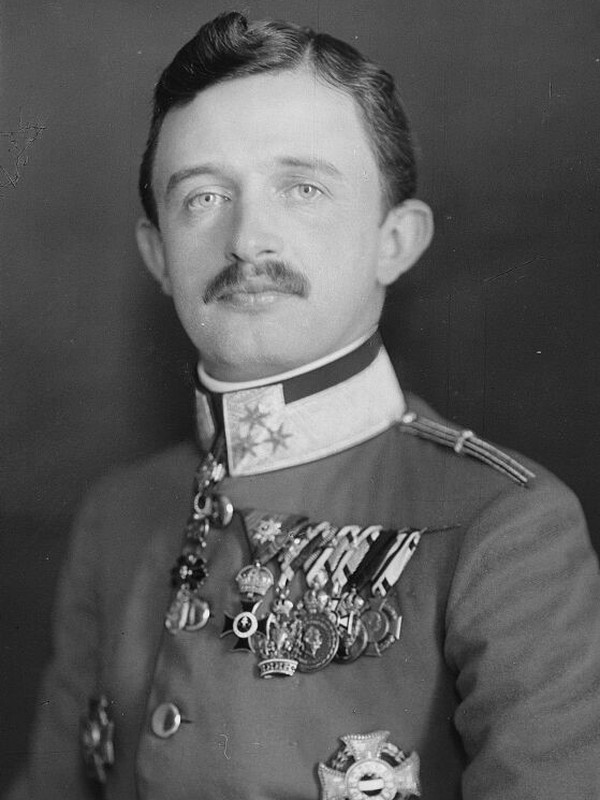

June-July 1917 Threefolding Memoranda. Karl came to the throne at age 29 with strong reformist intentions inherited from his uncle Franz Ferdinand's reform circle. By May 1917 he was telling Czernin that he saw German "Mitteleuropa" plans as "an attempt by the Hohenzollerns to bring Austria into complete dependence upon Germany"; he feared a German military victory because "a resounding military victory by Germany would be our ruin." On July 2, 1917, he issued comprehensive political amnesty for political "enemies of the state" including Czech leader Karel Kramář (which Reich-German nationalists construed as treason). He had appointed a federalist-leaning cabinet in May 1917. (Claims WiU-22-026, WiU-22-028.)Steiner'sThe last Habsburg emperor (reigned November 21, 1916 — November 11, 1918); the operational target of
The Sixtus Affair — Karl's secret separate-peace negotiations via his brother-in-law Prince Sixtus of Bourbon-Parma (early 1917, betrayed by Clemenceau April 1918) — was Karl's principal political vehicle. The Threefolding Memoranda were a parallel track. The Polzer-Hoditz delivery to Karl came too late (November 27, 1917 / February 17, 1918), by which time Karl was operationally committed to other negotiations. Karl delegated the memoranda to Minister-President Ernst von Seidler, who swept the matter under the table. Karl's last "Manifesto to the Peoples" of October 16, 1918 — attempting federalization of Cisleithania with extensive autonomy for the individual nations — was doomed; the propaganda of the Allies and the social disintegration after four winters of war had radicalized national demands beyond reach of imperial reform. Karl abdicated November 11, 1918; died of pneumonia in exile on Madeira April 1, 1922, age 34. Beatified by Pope John Paul II in 2004 as "servant of God" — the only beatification of a 20-c political ruler.