Record: record unknown How this text was taken down is not on record here. That is not an assurance of a stenogram.
Report on the Work and Travel Impressions in England
GA 228 — 9 September 1923, Dornach
My dear friends, this evening I would like to tell you something about the journey, and then give another talk tomorrow — since the next week has to be spent in Stuttgart and I will be dealing with some things that are perhaps more closely related in content to the things that I will also have to deal with today, as part of the description of the journey.
The journey began with Ilkley, in the north of England, where an educational course was to be held, a course dealing with Waldorf school methodology and didactics in relation to contemporary civilization. Ilkley is a town in the north of England with a population of about 8,000. At present there is a tendency in England to hold so-called summer schools at such places during the summer months, and this course was initially also in the form of such a summer school.
The course was to be accompanied by what we have developed in the anthroposophical movement in the way of eurythmy, and it was also to be accompanied by what six of our Waldorf school teachers could offer based on what has just been said in the individual lectures.
Ilkley is a place that is probably considered a kind of summer resort, but it is located in the immediate vicinity of those cities that really put you so deeply into what industrial-commercial culture is in our time. Leeds and other places are very close by, for example Bradford, and Manchester is not far away either. These are cities that truly reflect the life that has arisen from the present. One really has a feeling there that says very clearly how much the present needs a spiritual impact; a spiritual impact that is not limited to giving individual people something for their immediate individual-personal soul needs. It is certainly as justified as possible to see the anthroposophical movement in this light, but I am now speaking of the impressions that are really imposed on one by today's outside world.
You see, my dear friends, it is indeed the case that one would consider it an extraordinary, I would even say cultural paradox, if someone were to recommend adding indigestible mineral products - let's say any minerals, stones and so on - to human food, in other words, to regard it as something possible to add sand or the like to human food. One is compelled, on the basis of one's ideas about the human organism, to regard this as impossible. But anyone who is able to look more deeply into the structure and interrelationships of the world — and this may be said out of genuine anthroposophical feeling and perception — will have a special sense of a collection of houses and factories in such a style, which, so to speak, gives nothing to the aesthetic needs of human beings — as for example, in Leeds, where incredible-looking black houses are lined up in an abstract manner, where everything actually looks as if it were a condensation of the blackest coal dust, which has formed into houses in which people now live. If we consider this in connection with the development of culture and civilization of all mankind, and really do so with the same attitude as I have just applied to the sand in the stomach, we feel that we must say: It is just as impossible for human civilization for such a thing to become established in the long run in the whole course of human development and for human civilization to somehow progress inwardly.
Now it is really not the case that one could ever be a reactionary on anthroposophical ground. Of course, one must not speak of these things in a negative sense. These things have simply arisen out of the life of the whole evolution of the earth. But they are only possible within the development of humanity if they are imbued, permeated with a real spiritual life, if the spiritual life actually penetrates into these things and is gradually able to elevate them to a kind of aesthetics, so that people do not completely stray from the inner human through these things being placed in the unfolding of culture.
And I would like to say: it is precisely from such an experience that the most absolute necessity of a penetration of spiritual impulses into contemporary civilization arises. These things cannot be grasped merely in the sense of general ideas that one forms, but they must be grasped in connection with what is in the world. But one must have a heart for what is in the world!
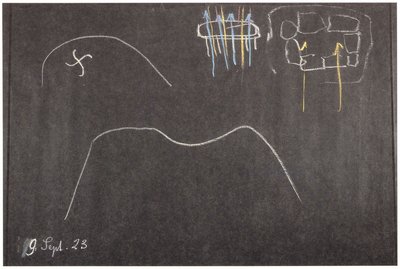
Ilkley itself is a place that, on the one hand, has the atmosphere of its proximity to these other, purely industrial cities, but on the other hand, there are traces everywhere in the surrounding remains of the dolmens, the old Druid altars, that are reminiscent of an ancient spirituality that has no direct successor there. It is, I would say touching, to perceive when on the one hand one has the impression that I have just described, and when on the other hand, in this region, which I would say is thoroughly permeated by the effluents of those impressions, one climbs a hill and then finds the remains of the old sacrificial altars with the corresponding signs in the extraordinarily characteristic places where they are always found - there is something extraordinarily touching about it. There is such a hill near Ilkley, with such a stone at the top. And on this stone, essentially – it is a little more complicated – but essentially what is known as a swastika, which was imprinted on the stones that were placed at certain sites at that time and what was imprinted on something very specific: it points to how at these sites the Druid priest was imbued with the same thoughts that, let's say, two to three millennia ago, were culturally creative in these areas. For when one enters such a place, stands before such a rock with the engraved signs, then one can still see from the whole situation today that one is standing in the same place where the Druid priest once stood and where he felt so strongly about the engraving of this sign that he expressed his consciousness, which he had from his dignity, in this sign.
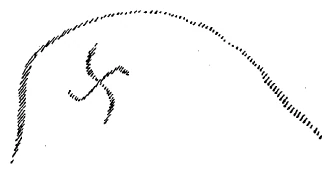
For what does one read in this sign when standing before such a stone? One reads the words that were in the heart of the Druid priest: Lo, the eye of sensuality beholds the mountains, beholds the places of men; the eye of the spirit, the lotus flower, the turning lotus flower – for its sign is the swastika – beholds the hearts of men, beholds the interior of the soul. And it is through this seeing that I want to be connected with those who are entrusted to me as a community. Just as one would otherwise read a text from a book, one reads this, so to speak, by standing in front of such a stone.
This is roughly the setting in which the Ilkley Conference was held. It consisted of my always giving the lectures in the morning, which this time, above all, tried to extract the Waldorf school pedagogy and didactics from the whole historical development of the art of education. This time I started from the way in which the art of education in Greek culture grew out of general Greek life, from which one can see that actually no special methods or special practices should be invented for school, but that school should impart what is contained in general culture.
It is certainly not right, for example, to invent special practices in Froebelian kindergartens – and I am not criticizing Froebel at all! – for doing this or that with the children, practices that are not connected to and have not grown out of general cultural life. Rather, it is right for the person practising the art of education to be directly involved in general cultural life, to have a heart and mind for it, and then to incorporate into the educational methods from direct life that into which the person to be educated is to grow later.
And so I wanted to show how pedagogy and didactics must grow out of our life, but now permeated by the spirit. This gave us the opportunity to shed light on the Waldorf school method from a different point of view. What I just mentioned was only the starting point; the subject at hand was an examination of Waldorf school pedagogy, which you are familiar with.
After that, there was a eurythmy performance by the children of the Kings Langley School and eurythmy performances by those eurythmy artists who had come with us at the Ilkleyer Theatre there. It would probably have been better if the latter had taken place first, so that it could have been seen in the order itself how what is cultivated as eurythmy in the school also grows out of eurythmy as an art that is part of cultural life. Well, these things will settle down in the future, so that in terms of external arrangements, too, a picture will be given of what is actually intended.
The third aspect, so to speak, was the achievements of those who had been involved as teachers at the Waldorf School. And here it must truly be said that the greatest possible interest was shown in the matter. I must say, for example, that the way in which Dr. von Baravalle presented his ideas was extraordinarily moving for anyone who cares about the development of the Waldorf School. When one saw how Dr. von Baravalle simply explained his geometrical views in the way they apply to children, using the method that you should know well from his book on physical and mathematical methods, and how then, from an artistic-mathematical development of surface transformation and surface metamorphosis, one might say, suddenly with an inner drama, the Pythagorean theorem emerged. When they saw how, after the audience had been led step by step and did not really know where it was all going, a number of surfaces were shifted until, at the end, the Pythagorean theorem was visualized on the blackboard by shifting the surfaces. There was an inner amazement among the audience, which consisted of teachers, an inner dramatic unfolding of thoughts and feelings, and I would like to say such an honest, sincere enthusiasm for what is coming into the school as a method that it was really moving – just as what our teachers presented in general aroused the most extraordinary interest. We had brought examples of our students' work, which consists of sculptural pieces, making toys, paintings, and so on. The greatest interest was aroused when it was described how the children work on these projects and how they fit into the school's overall curriculum.
The way in which music lessons are taught, as interpreted by Miss Lämmert, attracted the greatest attention, as did the discussions by Dr. Schwebsch. The insistent, loving way of Dr. von Heydebrand, then the forceful way of our Dr. Karl Schubert; all these are things that really showed that it is possible to bring the essence of the Waldorf school system to the soul of a teaching staff in a vivid way. Miss Röhrle then gave a eurythmy lesson for different people, which was also a good addition, so that the whole thing was quite well summarized from an educational point of view. I can say that because I had no part in putting the program together. All of this was put together by our English friends in such a way that it really was a very nice summary of the educational subject.
During the whole conference, a committee was formed which set itself the task of founding an independent school in England based on the model of the Waldorf School. The prospects are actually very good for such a school to be established as a day school, alongside the Kings Langley School, which had already agreed last year, after my Oxford lectures, to adopt the Waldorf school methodology. As I said, it was the children of the Kings Langley School who had presented what they had learned in eurythmy at the theater in Ilkley. The interest and the way in which these things have been received, and also how sympathetically the eurythmy performances have been received, is something that can already be very satisfying. This was the first half of August, until August 18. Then we hiked over to Penmaenmawr.
Penmaenmawr is a place in North Wales, on the western English coast, where the island of Anglesey is located, and this Penmaenmawr is a place that could not have been better chosen for this anthroposophical undertaking this year. For this Penmaenmawr is filled with the directly tangible astral atmosphere, into which the young man shaped himself, who had emerged from the Druid service, traces of which can be found everywhere. It is right on the seashore, as I said, where the island of Anglesey is located; a bridge, which, by the way, is ingeniously built, leads over to it. On one side, hills and mountains rise everywhere near Penmaenmawr, and on these mountains you can find the remains of the old so-called sacrificial altars, cromlechs and so on scattered all over the place; there are traces of this ancient Druidic service everywhere.
These individual scattered cult devices, if I may call them that, are apparently arranged in the simplest way. If you look at them from the side, they are stones arranged in a square or rectangle, with a stone lying on top. If you look at them from above, these stones would stand like this [see drawing], and then a stone lies on top, enclosing the whole thing like a small chamber.
Of course, such things were also grave monuments. But I would like to say that in older times the function of a grave monument is always connected with the function of a much more extensive cult. And so I do not want to hold back here from expressing what such a cult site can teach us.
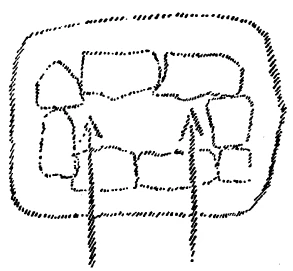
You see, these stones enclose a kind of chamber; a capstone lies on top of it. This chamber is dark in a certain way. So when the sun's rays fall on it, the outer physical light remains. But sunlight is filled with spiritual currents everywhere. This spiritual current continues into this dark space. And the Druid priest, as a result of his initiation, had the ability to see through the Druid stones and see the downward flow - not of physical sunlight, because that was blocked - but of what lives spiritually and soulfully in physical sunlight. And that inspired him with what then flowed into his wisdom about the spiritual cosmos, about the universe. They were therefore not only burial places, they were places of knowledge.
But even more. If at certain times of the day this was the case, what I have just described, then one can say: at other times of the day the opposite was the case, that currents went back from the earth [upwards], which could then be observed when the sun was not shining on them, and in which lived that which were the moral qualities of the community of the priest, so that the priest could see at certain times what the moral qualities of his community children were in the surrounding area. So the descending spiritual substance as well as the ascending spiritual substance showed him that which allowed him to stand in a truly spiritual way in his entire sphere of influence.
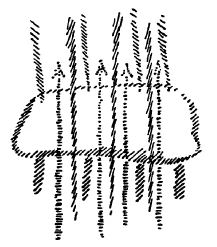
These things are, of course, not recorded in what today's science tells us about these places of worship. But it is indeed what can be seen here directly, because the power of the impulses – the impulses from the work of the Druid priests in the time when it was their good time – was so strong that even today these things are absolutely alive in the astral atmosphere there.
I was then able to visit another type of place of worship with Dr. Wachsmuth: from Penmaenmawr, you have to walk about an hour and a half up a mountain. At the top, there is something like a hollow. From this hollow, you have an unobstructed, wonderful view of the surrounding mountains and also of the hollow boundary of your own mountain. Up there in this hollow, one found what can be described as the actual sun cult site of the ancient Druids. It is arranged in such a way that the corresponding stones are arranged with their cover leaves; the traces are present everywhere.
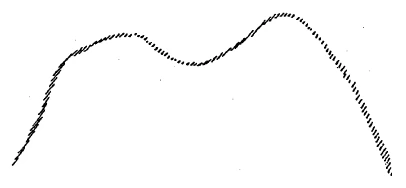
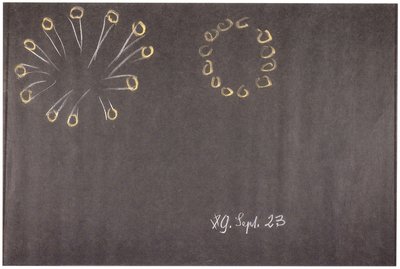
Think of it this way: these places of worship have no inner space. Up here, in close proximity to each other, you have two such Druidic circles. When the sun makes its daily path, the shadows of these stones fall in a variety of ways, and you can now distinguish, let's say, when the sun passes through the constellation of Aries, the Aries shadow, then the Taurus shadow, the Gemini shadow and so on. Even today, when deciphering these things, one still gets a good impression of how the Druid priest was able to read the secrets of the universe from the various, qualitatively different sun shadows that this Druid circle revealed, from that which lives on in the sun shadow when the physical sunlight is held back, so that in fact it contains a world clock that speaks of the secrets of the world. But these were definitely signs that emerged from the shadows that were cast, signs that spoke of the secrets of the world and the cosmos.
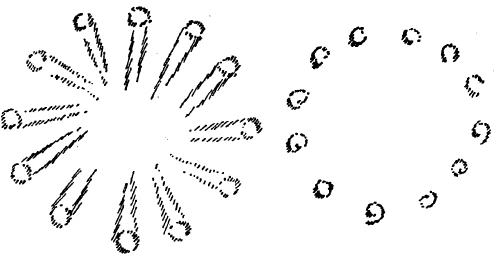
The second circle was then a kind of control to check what the first circle had revealed. If you had gone up in an airplane and gone so far away that this distance in between might have disappeared, you would have had, looking down, the ground plan of what the ground plan of our Goetheanum was, directly from these two druid circles.
All this is located where the island of Anglesey is also close by, where much of what has been preserved in the accounts of King Arthur took place. The center of King Arthur was a little further south, but some of the events that took place there were also part of King Arthur's work. All this gives the astral atmosphere of Penmaenmawr something that makes this place in particular a special one, one of which one can say: when speaking about spiritual things, one is compelled to speak in imaginations. It is the case with imaginations that when they are formed in the course of the representations, these imaginations in the astral atmosphere within today's civilization very soon disappear. When one tries to depict the spiritual, one is constantly fighting against the disappearance of the imaginations. One has to create these imaginations, but they quickly fade away, so that one is constantly faced with the necessity of creating these imaginations in order to have them in front of oneself. The astral atmosphere that results from these things is such that it is a little more difficult to form the imaginations there in Penmaenmawr, but that this difficulty in turn leads to a great relief of the spiritual life on the other hand, that now these imaginations, after they are formed, simply look like they have been written into the astral atmosphere, so that they are inside. Every time one forms imaginations that express the spiritual world, one has the feeling that they remain in the astral atmosphere there. And it is precisely this circumstance that so vividly reminds us of how these Druid priests chose their special places, where they could, I would say, effectively engrave in the astral atmosphere what was incumbent upon them to shape in imaginations from the secrets of the world. Coming from Ilkley, which is very close to industrialism and shows only very slight traces of the ancient Druidic period, one feels a kind of real transcendence, almost like crossing a threshold, and now entering into something that is simply spiritual in the immediate present. Everything here is spiritual. You could say that this part of Wales is a very special place on Earth. Today, this Wales is the custodian of an incredibly strong spiritual life, which admittedly consists of memories, but real memories that stand there. So that it may actually be said: the opportunity to talk about Anthroposophy at this place – not in reference to the branches of Anthroposophy, but about Anthroposophy itself, about the inner core of Anthroposophy – I count that as one of the most significant stages in the development of our Anthroposophical life.
The credit for having made this institution, for having placed something like this in the development of anthroposophical life, goes to Mr. Dunlop, who is extraordinarily insightful and energetic in this direction. He explained the plan to me when I was in England last year and then stuck to it and has now brought it to fruition. From the outset, it was planned to bring something purely anthroposophical in connection with eurythmy to this place this August.
Mr. Dunlop then had a third impulse, but it was impossible to carry out, and it may be said that what has become possible has only become possible through the truly spiritually insightful way of choosing this place. I think it is of some importance to bear in mind that there are such outstanding places on the earth's surface where, in such a vivid memory, there is an immediate awareness of what was once a living sun cult in preparation for the later adoption of Christianity in Northern and Western Europe.
The lectures were in the morning; the afternoon was partly devoted to allowing the participants to see this astral atmosphere and its connection to the memories of decaying sacrificial sites, dolmens and so on, on the spot; the evening was filled with discussions on anthroposophical topics or with eurythmy performances. There were five of them in. Penmaenmawr, which were received with great sincerity on the one hand and with the greatest interest on the other. The audience consisted partly of anthroposophists, but also of a non-anthroposophical audience. It was certainly the case that — which is, of course, understandable for a mountainous area bordering the sea — from one hour to the next there was always a nice change from half-downpours to bright sunshine and so on. For example, one evening — the external furnishings were almost the same as in this carpentry workshop — we really did go from a downpour to a eurythmy performance; at the beginning, people were still sitting in the hall with their umbrellas, but they did not let themselves be deterred in their enthusiasm. So it was definitely something, as I said in Penmaenmawr itself, that can truly be recorded as a very significant chapter in the history of our anthroposophical movement.
One event was dedicated to discussing educational questions in Penmaenmawr as well. And on this occasion, I would also like to mention the following, which you have already been able to read in the brief presentation I gave of it in the “Goetheanum”. When I came to England, to Ilkley, I found a book called 'Education Through Imagination', which I was able to skim through at first and which immediately captivated me; a book that one of our friends in particular describes as one of the most important books in England. Its author is Miss MacMillan. The same person was then chairman on the first evening and the following evenings in Ilkley. Miss MacMillan gave the opening speech. It was uplifting to see the beautiful enthusiasm and the inner honest fire for the art of education in this woman. And at the same time, it was extraordinarily satisfying for us that this woman in particular is fully committed to what can be achieved in a truly serious art of education through the Waldorf school methodology.
During the following days, I read more of the book and summarized my impressions in the article in the last issue of the Goetheanum. Then, last Monday, Frau Doctor and I were also able to visit the place of work of this excellent woman in Deptford, near London and Greenwich. There we found the Miss MacMillan Care and Education Institute. She takes children from the lowest and poorest social classes into this care and education institute; she also aims to take children at an older age. Today she has 300 children at the school; she started with six children many years ago, today there are 300. These children are taken in at the age of two, coming from circles where they are very dirty, impoverished, sick, malnourished or very poorly nourished – if I may say so, rickety, typhoid, afflicted with worse. Today you can see a kind of school barracks in the immediate vicinity, like those of the Waldorf School – the barracks, not our current opulently built house, the provisional barracks – but there they are very beautiful, nicely furnished. The things are in a garden, but you only have to take a few steps from any of the Iore and then you can compare the population from which these children come, living on the streets in the most terrible squalor and filth, with what is being done with these children.
First of all, the bathing facilities are exemplary. That is the main thing. The children arrive at 8 o'clock, are released in the evening, and thus return to their home every evening. The care begins in the morning with a bath. Then a kind of teaching begins, all done with tremendous devotion, with a touching, poignant sense of sacrifice, all arranged in a touching, practical way. Miss MacMillan is also of the opinion that the education of the Waldorf School must penetrate everything, so one must say: one can see that from this point of view with complete satisfaction – while today one might want to do some things differently in terms of methodology; but that is not considered at all in the face of this sense of sacrifice. Things are always in a state of becoming. It is truly significant how well-mannered these children become, which is particularly evident during mealtimes, when they are led to the table and serve themselves, or when the food is passed by one of the children. What practical sense can achieve is shown, for example, by the fact that this, I would like to say extraordinarily homely, “feeding” of the children, during which one would like to eat along, costs 2 shillings 4 pence for the child during the week. Everything is extremely well organized. It was wonderful, for example, to see how the older children, who have been at the center for years, were called together and then presented us with a long scene from Shakespeare's “Midsummer Night's Dream,” the Midsummer Night's Dream, with real feeling and even a certain mastery of dramatic technique. There was something touchingly magnificent about the way these children performed it, expressively and impressively, with real inner control of the drama.
And this performance of Shakespeare's “Midsummer Night's Dream” was almost in the same place where Shakespeare himself once performed his plays for the court with his troupe. Because near Greenwich was the court of Queen Elizabeth. There, in the rooms where today's classrooms are located and other rooms, as I will explain in a moment, even the royal household of Queen Elizabeth lived, and Shakespeare, coming from London, had to perform his plays for the courtiers there. The children performed these Shakespeare plays for us at the same location.
And in the same area, connected to this educational mental hospital, is a children's clinic, again for the poorest of the poor. Every year, 6,000 children go through this clinic, not 6,000 at the same time, but every year. The head of this clinic is now also Miss MacMillan. So that in a very impoverished and polluted area, in a terrible area, a personality is working with full energy and actually great in the conception of what she is doing.
It was therefore a very deep satisfaction for me when Miss MacMillan expressed the intention, if at all possible, to visit our Waldorf School in Stuttgart with some of her colleagues at Christmas. This teaching staff is extraordinarily devoted. You can imagine that caring for such children, with the characteristics I have just described, is not exactly easy. It therefore filled me with great satisfaction that this particular person was the chairman for the Ilkley lectures, and then in Penmaenmawr – where she came again in the few days that she could bring herself to do so – she introduced a discussion on education in which Dr. von Baravalle and Dr. von Heydebrand spoke. So it was precisely what took place at Penmaenmawr and what was connected with it that was really quite satisfying.
The last part, so to speak, was the third part, which was the days in London. Dr. Wegman had come over for what was to be my first task in London. We were to present the method and essence of our anthroposophic medical efforts to a number of English doctors. Forty doctors were invited, and most of them appeared at Dr. Larkin's house. I was able to speak in two lectures, first about the special nature of our remedies in their connection with the symptoms and with the nature of the human being. And then in the second lecture I was able to give a physiological-pathological basis for the functions of the human being; then something about the mode of action of individual remedies, again in connection with this basis, the effects of the antimony remedy, the effects of mistletoe and so on – and I believe we can truly say that perhaps a fairly good understanding of the matter has been brought to bear, even in a wider circle, as evidenced by the fact that Dr. Wegman was consulted quite frequently. So this aspect of anthroposophical work has also come into its own.
The finale was a performance at the Royal Academy of Art, which was an extraordinary success. The room is not particularly large, but not only was it sold out, people also had to be turned away. The eurythmy was received with extraordinary enthusiasm. One could say of eurythmy that wherever it goes, it makes its way. If only it were not for the enormous obstacles that exist in the present time! On the one hand, when one sees all that is going on, for example, the tendency of the Ilkley enterprises to now have a kind of Waldorf School emerge in England, then one looks again with a great concern, which cannot leave one today, at what one, I would like to say, encounters as an indefinite, painful response when one asks oneself: What will become of the Waldorf school in the terribly endangered Germany, from which, for example, the school efforts have emerged? I say this not so much because of the pecuniary side of the matter, but because of the extremely endangered circumstances within Germany. There are some things that make you say: If things continue as they are now, it is hard to imagine where the efforts of the Waldorf School in particular will lead.
After all, if things continue as they are now, as they have arisen from what is currently happening, there will hardly be any possibility of bringing such things through the current turmoil without danger. Then one has a heavy heart when one sees how these things are happening after all, and how in fact today all things in the world happen out of shortsightedness and without any inkling that spiritual currents must play a part in the development of culture, and how in fact in the widest circles people have lost all direct interest, all hearty engagement with things. Basically, we are all asleep when it comes to things that go so terribly to the root of human and earthly becoming. Humanity is asleep. At most, one complains about the matter when it is of immediate concern. But things do not happen without the development of great ideas! And there is such a dullness in the world towards the impulses that are to strike: Either one does not want to hear about it, or one feels uncomfortable in the world when something like the endangered situation in Central Europe is pointed out. One feels uncomfortable, one does not like to talk about it, or one colors it in a certain way and speaks of insubstantial things, of guilt and the like. In this way one gets rid of these things. The way humanity relates to general world events today is something that can be terribly painful for the soul. This general cultural sleep, which is becoming more and more widespread, is basically something quite terribly lamentable. There is actually no awareness of how the earth today, in its civilization, forms a unity, even in the face of such elementary events – I do not want to talk about them here, but they have happened – such as the poignant Japanese tragedy brought about by nature. Yes, when one compares how people looked at these things relatively recently and how they look at them today, there is something that really does bring home to one again and again the necessity of pointing out how urgently humanity needs to wake up.
Of course, this is always in front of you, especially when you see what could become of it if people would take an interest, if people would come to take things as they are, if they would not take them in terms of national divisions, in terms of state divisions, but in a general human sense! When one sees on the one hand what could become of it, and when on the other hand one sees how it is almost impossible because of general lethargy, then this actually characterizes, I would say, our present age most of all. That is the way things are. One cannot speak of the one without the other also arising in the context.
I wanted to give you a kind of travelogue today, my dear friends. I will speak about questions of intellectual life, which are, of course, more distantly related and which are actually also anthroposophical in content, tomorrow, after this.
My lecture will take place tomorrow at 8 a.m.; on Tuesday at 8 a.m. there will be a eurythmy performance here.
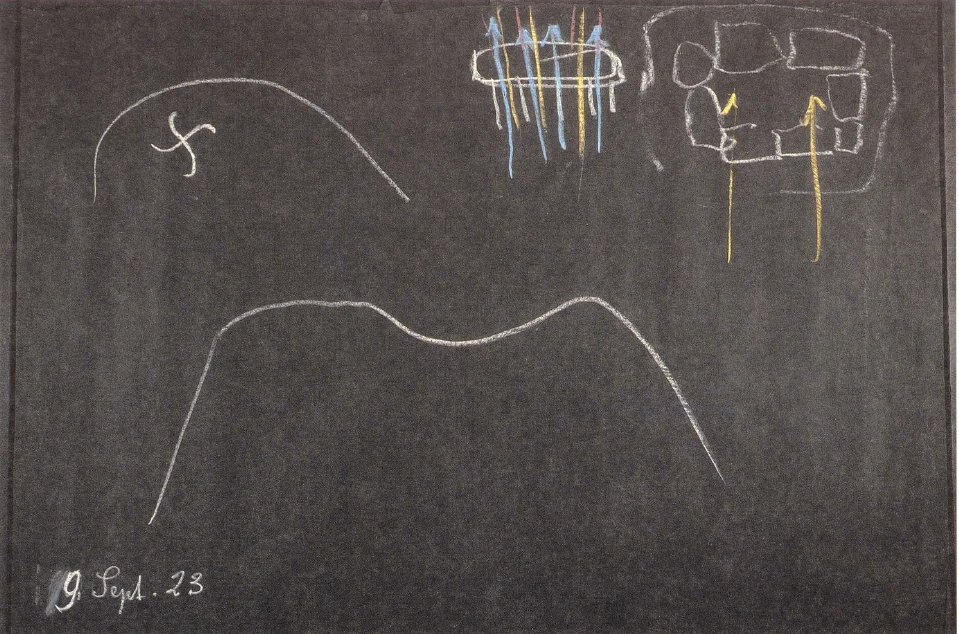
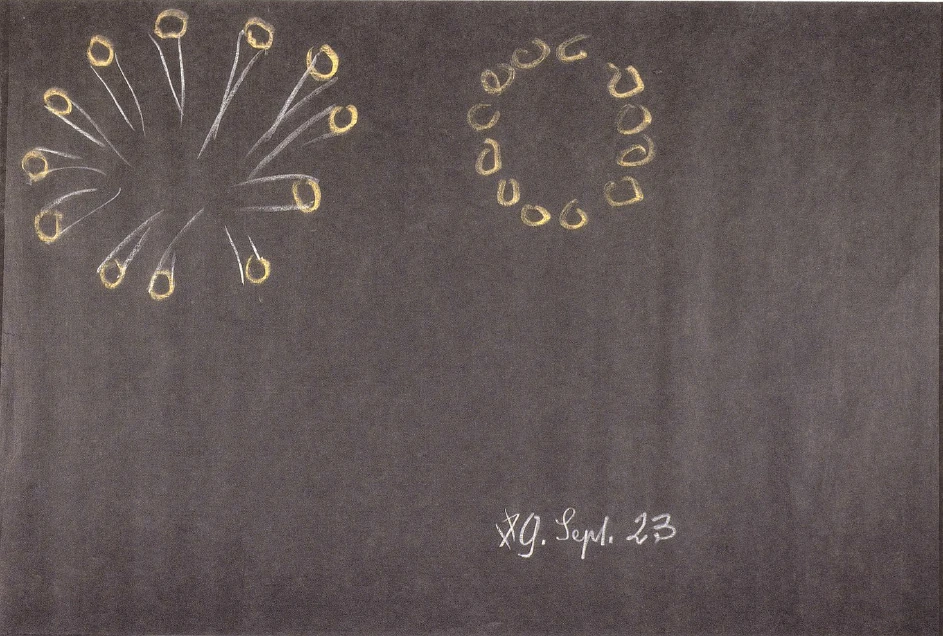
Blackboard drawings
2 drawings Steiner made on the board during this lecture, as the publisher's edition prints them.