Record: record unknown How this text was taken down is not on record here. That is not an assurance of a stenogram.
Mystery Knowledge & Mystery Centres
GA 232 — 2 December 1923, Dornach
6. The Ephesian Mysteries Of Artemis
When man today speaks of the word, he means, as a rule, only the weak human word which has so little significance in comparison with the majesty of the Universe indicated at the beginning of St. John’s Gospel with the momentous words: In the beginning was the Word, the Logos, and the Word was with God, and a God was the Word. Anyone who meditates on this most significant opening of St. John’s Gospel must ask himself: What does it mean, when the Word is placed at the primal beginning of all things? What is meant by the Logos, the Word? And how is this connected with our trivial human words?
The name of John is also connected with the city of Ephesus, and Imaginative perception of the world’s history, the significant saying, Tn the primal beginning was the Logos, and the Logos was with God, and a God was the Logos’, will lead one again and again, by an inner path, back to the ancient Temple of Diana at Ephesus. For one who has attained a certain degree of Initiation, the enigma presented in the first verses of St. John’s Gospel points to the Mysteries of the Temple of Diana, at Ephesus. And so it must seem to him that knowledge of the Mysteries of Ephesus will help him to understand the beginning of St. John’s Gospel.
Prepared by what we have heard in the last two lectures, let us think of the Mysteries of the Temple of Diana at Ephesus as they were six or seven centuries before the birth of Christianity, or even earlier, and of what was done in this sanctuary that was held to be so holy by the men of that olden time. We find that the instruction given in the Mysteries at Ephesus was primarily concerned with the processes active in human speech. We can learn—not from any historical account, for the barbarism of humanity takes good care that such records are destroyed—we can learn from the Akashic Record, that thought-record in the ether and accessible to spiritual sight, where the events of world-history are inscribed, from this record we can learn of the teachings given in these Ephesian Mysteries. And the Akashic Record reveals again and again how the teacher directed the attention of the pupil to human speech. Again and again he was exhorted: Learn to feel in your own instrument of speech what it is that takes place there when you speak!
The processes at work in speech elude crude perception, for they are delicate and intimate. But let us consider first of all the external aspect of speech, for it was from this that the instruction given in these Mysteries took its start. The attention of the pupil was first directed to the way in which the word sounds forth from the mouth. He was told, over and over again: Mark well what you feel when the word sounds forth from your mouth! He was then taught to notice how something of the spoken word turns upwards in order to receive the thought in the head; while something from the same word takes its way downwards in man, in order that the feeling-content may be experienced inwardly.
Again and again the pupil was instructed to force his speech through the larynx, carrying it to its extreme limits, and thereby to perceive the ebb and flow manifest in the word as it is uttered. ‘I am, I am not’—a positive assertion and a negative assertion—these he had to utter as articulately as possible and then to observe how, in the words ‘I am’, the ascending upwards is felt, while in the ‘I am not’ there is rather the feeling of pressing downwards.
The attention of the pupil was then turned more towards the intimate, feelings and experiences connected with the word. He became aware that from the word something like warmth mounts up towards the head; and this warmth, this fire, grasps the thought. And there is also a flowing downwards as it were of a watery element, pouring itself out downwards, like a glandular secretion in the human organism. Thus it was made clear to the pupil in the Ephesian Mysteries: this is how man makes use of the air in order to let the word sound forth; but in the act of speaking the air transforms itself, into the next element, into fire, into warmth, draws down the thought from the heights of the head, and embodies it in itself. And again, another change ensues: not only is there a sending upwards of fire, but a sending downwards of the fluid element contained in the word: the air trickles down as it were like a glandular secretion, as water, as a fluidic element. By means of this latter process the word becomes inwardly perceptible; it can be felt inwardly.
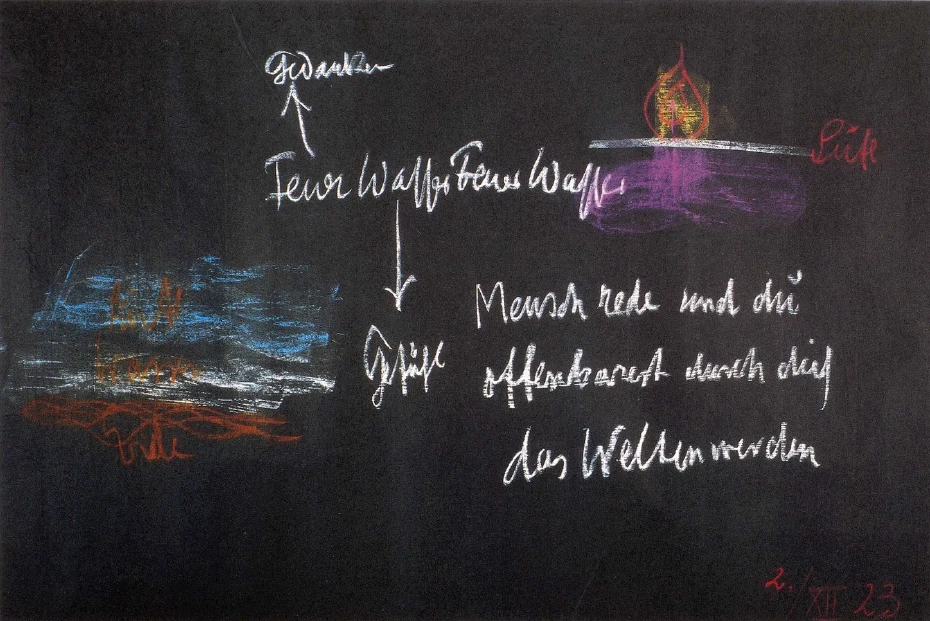
The pupil was then led into the real secret of speech. But this secret is connected with the secret of Man. This secret of Man is today hidden from the scientists, inasmuch as science places at the summit of all thought the incredible caricature of a truth, namely, the so-called law of the conservation of energy and of matter. In man, matter is continually being transformed. It does not endure. For instance, the air that forces its way out of the throat is transformed in the process into the next higher element, fire; and again also into the water-element—Fire, Water; Fire, Water.
The pupil at Ephesus came to understand how, when he spoke, a wave went forth from his mouth: Fire, Water; Fire, Water. This was nothing more or less than the striving upward of the word towards thought, and the trickling downward of the word towards feeling. Thus are thought and feeling interwoven in man’s speech, inasmuch as the living wave of speech, beginning as air, first rarefies to fire, then densifies to water, and so on, again and again.
Fire => Thought, Water => Feeling, Fire, Water
The great truth relating to his own speaking was brought home to the pupil in the Mysteries of Ephesus, in these words:
Speak, O Man, and thou
revealest through thyself
the Becoming of Worlds.1
When the pupil came to the portal leading into the Mysteries, these were the words addressed to him:
Speak, O Man, and thou
revealest through thyself
the Becoming of Worlds.
And when he left the Mysteries, the words resounded to him in a different form:
World-Becoming reveals itself
through thee, O Man,
when thou speakest.
Then the pupil began to feel that he himself enveloped with his own body, as with a sheath, the Cosmic Secret which sounded from his breast and was contained in his speech.
All this was brought to the pupil as preparation for the really deeper secret. For this preparation enabled him to know how his own human nature is inwardly connected with the secret of the Cosmos. The saying ‘Know thyself!’ acquired a holy significance inasmuch as it was not uttered as theory but inwardly and solemnly felt and experienced.
Then, after the pupil had ennobled his being in this way, and was able to feel his manhood as a vessel enveloping the Cosmic Secret of the Cosmos, he could be led still further and come to know the power which spread the Secret over the wide spaces of the Cosmos.
Let me remind you here of what was said in the last lecture. I described a condition in the evolution of the Earth when the following occurred. We know that during this ancient period there was present in the Earth even then, as a substance essential for that stage of evolution, what we now know as opaque chalk such as is found, for instance, in the Jura mountains. In the chalk mountains, in the chalk of the Earth today, we have what is to be observed in that ancient period when the Earth was surrounded by what I called the ‘fluid albumen’. Cosmic forces worked into this fluid albumen, causing it to coagulate into certain definite forms; and while the Earth was in this condition a process took place resembling in a higher degree and in a denser substance what we know today as the rising of the mist and falling of the rain. The chalky element rose upwards and permeated what had hardened in the fluid albumen, so that these forms acquired a bony content. The result was that the animal came into being in the course of Earth-evolution. Through the spirituality contained in the chalk the animals were drawn down, as it were, out of the still albuminous atmosphere.
I also said that if a man unites his being with the metallic element, the ‘metallity’ of the Earth, he can inwardly feel and experience; everything that happened in that remote past, he can feel it in his own being, as a memory. At that stage of evolution man did not yet feel himself to be a little human being enclosed in his skin; he felt that he embraced the whole earthly sphere. To put it rather grotesquely, I should say: man felt that his head embraced the whole Earth-planet.
The processes described in the last lecture were felt by man to be taking place in himself. But how? Everything I have described to you here as the rising of the chalk, the uniting of this chalk with the coagulated albumen and then the descent of the animal-nature on to the Earth—all this was experienced by man at that time in such a way that he heard it. You must try to imagine this. He experienced it inwardly, and in so doing he heard it. The forms that arose when the chalk filled out the coagulated albumen and made it bony and gristly—all that then took shape, was ‘felt’ in the ear, it was audible. The Cosmic Mystery was heard.
And it is the same today, when man learns in memory about the past of the Earth the memory that is kindled by the metals. It is as if he hears it. And in the sound the stream of cosmic happenings fives and weaves.
What is it that man hears? What is revealed, what is disclosed to him? The stream of cosmic happenings reveals itself as the Word of the World, as the Logos. It is the Logos, the Word of the World, that resounds in the arising and falling of the chalk. And when man is able to perceive and understand this language, he learns something else besides.
What modern anatomy says about a human or an animal skeleton is dreadfully external. But when, with inner mindfulness of the reality of Nature and of Spirit we look at a skeleton, what do we feel? We say to ourselves: Do not merely look at it. It is terrible merely to look at it as it stands there with its forms: the spinal column with its wonderfully shaped, intersecting vertebrae, with the ribs bending and curving forwards with all the wonderful articulation as the vertebrae are metamorphosed into the bones of tire skull; and that even more mysterious articulation where the ribs, bending to embrace the breast from either side, then with a sharp turn form themselves again to the bones of the arm and the bones of the leg! Confronted with this mystery of the skeleton, we can do no other than say to ourselves: Do not merely look, but listen. Listen how one bone transforms itself into another. Listen—for it speaks!
At this point let me make a personal remark. When with a feeling for these things we go into a natural history Museum, we are confronted by something really miraculous. For there we have a collection of what are really musical instruments forming a mighty orchestra and resounding in the most wonderful way. I experienced this very deeply when I once visited the Museum in Trieste. There, owing to a particular arrangement—made quite instinctively—of the animal skeletons, one could hear resound, one after the other, at one end of the animal the secrets of the Moon and at the other end the secrets of the Sun. The whole room was as though filled with the tones of Sun and planets. One could feel the connection between the skeleton—the bony-system living in the chalk—and that which once upon a time spoke to man out of the weaving Cosmos, when he himself was one with this Cosmos, with the secret of the Universe, which is at the same time the secret of Man himself.
The beings which came into existence at that time—the animal beings to begin with—spoke forth what they are; for the animal-nature lived in the Logos, in the sounding Mystery of the World. There were not two separate phenomena to be perceived. One did not perceive the animals, and then in some way or other the inner nature of the animals. The animals themselves, living and moving in their own essential being—that was what spoke.
The pupil of the Ephesian Mysteries could take into his soul, into his heart, in the right way for that ancient time, what could then be revealed to him concerning the primal Beginning, when the Word, the Logos, was moving and weaving as the living essence of all things. The pupil could receive it because he had been prepared by having ennobled and sublimated his human nature, in that he felt himself to be a vessel for the faint reflection of the Cosmic Mystery which lay in the sounding of his own speech.
And now let us consider how the evolutionary process has passed, as it were from one level to another. In the chalk element there was still something perfectly fluid. It rose as vapour, fell again as drops of rain. It was fluid. As it rose it was transmuted into Air. When it descended it was changed into Earth, and so we have, firstly Water, then Air and Earth. Now this is one level deeper than in the human copy of it: Air, Warmth, Water. In those primeval times the still fluid chalk rarefied to Air and condensed to Earth; just as in our larynx today the Air rarefies to Warmth and condenses to Water. And thereby it is possible for human beings to encompass this Cosmic Mystery in miniature. When it was still the mighty Maya of the Cosmos it was at a deeper level. The Earth densified everything. The chalk became denser, and so on. We human beings would not have been able to receive the Cosmic Mystery in this form, we could not have held it even in miniature. This was possible for us only because it rose one stage higher, from Water to Air; and therewith it begins to surge upwards into Warmth and downwards into Water—which is now the denser element.
Thus did the great Macrocosmic Mystery become the Microcosmic Mystery of human speech. It is this Macrocosmic Mystery, to which the beginning of St. John’s Gospel points. Tn the primal, beginning was the Word, the Logos, and the Word was with God, and a God was the Word.’ For that was still a living tradition in Ephesus, at the time when the Evangelist, the writer of St. John’s Gospel, could read there in the Akashic Record that for which his heart yearned namely, the right wording in which to clothe what he had to say to mankind concerning the secret of Cosmic Evolution.
But we can go a stage further. We can remind ourselves of what was said in the last lecture, namely that preceding the chalk there was the silica, which appears today in quartz. In this there appeared the plant-forms as I have described them—those great cloud-forms greening and fading away. And if, as I said, a man had been able at that time to look out into the wide spaces of the Cosmos, he would have seen this evolution of the animal nature, he would have seen, too, those primeval plants greening and passing away. All this was an inner experience in man. He perceived it as belonging to his own being. Nor was this all. For while he heard as a living inner experience the ‘sounding’ of the animal-nature coming into being, he could also in a certain sense accompany inwardly what he heard; as in his own head, in his breast, in his heart, he ascended with the words through the Warmth to grasp the element of Thought, so he could accompany what he heard resounding from the creation of the animals and follow what was experienced in the evolution of the plants.
This was the strange thing, my dear friends. Man could experience the weaving and working of the creation of the animals in the rarefying and descending chalk. And when, going further, knowledge came of what was in the silica, the plant-beings becoming green and again losing colour, then the Cosmic Word became Cosmic Thought; through the plant living in the silicious element Thought was added to the resounding Word.
We take a step upwards and Cosmic Thought is added to the sounding Logos, just as today, when speech goes out on a wave of Fire, Water, Fire Water, in the element of Fire the Thought is grasped by the resounding word.
Even today, if you study how to deal with certain pathological conditions connected with the sense-organs of the head, or with the sense-organs in general, you will learn of the healing effects of silica. Silica then appears to you as the Thought-element among the secrets of the Cosmos and you behold it as such in the greening and fading of the original plant-forms. Was I not able to say that through it the Earth perceives the whole structure of the Cosmos? In a wonderful way there is expressed in present-day man, microcosmically, that which once was macrocosmic, that which once was the weaving and moving, the very coming-into-being, of the Cosmos.
Just think for a moment how man lived then, lived still at one with the Cosmos, in unity with the Cosmos. When a man thinks today he has to picture himself isolated in his head. Inside his head are his thoughts, and the words come forth from there. The Cosmos is outside; words can only point to the Cosmos, thoughts can only mirror the Cosmos. It was not so when man was still one with the Macrocosm. Then he experienced the Cosmos as though it were within himself. The Word was his environment; and Thought was that which permeated and streamed through this environment. Man listened; and what he heard was World, was Cosmos. He looked upwards from what he heard, but he looked upwards within himself. The Word was first Tone. The Word was first something which struggled, as it were, for the solution of its own riddle. In the creation of the animal something that struggled for a solution was revealed. The animal kingdom arose within the chalk as a question. Man turned to the silica; he looked into the silica, and there the plant-creation gave the answer; the silica gave the answer to the riddle set by the animal creation. It was the beings themselves who solved each other’s riddles. One being, in this case the animal, put the question. The other being, in this case the plant, gave the answer. The whole Cosmos became Speech.
This is the reality contained in the words at the beginning of the Gospel of St. John. We are pointed back to a primal beginning of everything we see all the time around us today. In this primal Beginning, in this Principle, was the Word, and the Word was with God, and a God was the Word, for it was the creative essence in everything.
It is really the case that in the teaching concerning the Primal Word given to the pupils of the Mysteries at Ephesus lies that which afterwards led to the beginning of St. John’s Gospel. And here let me say that the time is fully ripe for anthroposophists to turn their attention to these secrets which rest in the womb of the Ages. For you see, in a very particular and special sense, the Building that stood here on the Dornach hill, the Goetheanum, had become the central point of anthroposophical striving. The pain in us today must live on further as pain, and will do so in everyone who was able to feel what the Goetheanum was intended to be. But whatever takes place in the physical world around us, that, my dear friends, for one who is striving upwards in his knowledge towards the Spiritual, must be at the same time an external revelation, a picture of something deeper, something spiritual. If, on the one hand, we have to experience this pain, then we, as human beings striving for spiritual knowledge, must nevertheless be able to turn what has happened into an opportunity for looking into an ever-deepening revelation. This Goetheanum was truly a place in which one longed to speak, in which one did speak again and again, of the things that are connected with the beginning of St. John’s Gospel: In the beginning was the Word, the Logos, and the Word was with God and a God was the Word.
The Goetheanum went up in flames of fire; and this terrible picture of the burning Goetheanum stands before us. Out of the pain can be born the demand and the call to look ever more deeply into that which is always there if only our thought is strong enough to see it, the call to look ever more deeply into the burning Goetheanum as it stood there in the flames of that New Year’s Eve. Although this was such a painful event, it was nevertheless one which can lead us into greater and greater depths of knowledge. Something was to have been founded there, something that had a connection with the Gospel of St. John. In a certain sense we may say that this placed itself into the consuming, burning flames, it was borne upwards in the flames. And mighty indeed is the impulse that can lay hold of us, to let those flames prompt us to look through them to other flames, to the flames that once upon a time consumed the Temple at Ephesus. Let that be a challenge to us to seek a meaning, a significance, for what is contained in the beginning of St. John’s Gospel. Urged on by these painful but holy impulses, let us look back from that Gospel to the Temple at Ephesus which was also burnt down, long ago; and then the Goetheanum flames which speak so painfully and so eloquently, will serve to remind us of what streamed into the Akashic Records with the flames of the burning Ephesian Temple. When we turn our eyes to that tragic night, to the flames of the burning Goetheanum, did we not see, do we not still see, the molten metals of the musical instruments? And have we not within the flames these metals of the musical instruments uttering in clear tones their holy speech, enchanting into the flames the most marvellous colours, eloquent colours, colours that speak, colours that are akin to the metals? Through union with the metals there rises up within us something that is like memory in the earthly sphere. And this memory unites us with what was burned together with the Temple at Ephesus. Then, even as there is a connection between those two burnings, so the longing to learn the meaning of the opening words of St. John’s Gospel can link us to what was brought home again and again to the pupil at Ephesus: Study the mystery of Man in the little word, the Micrologos, in order to make yourself ripe to experience within yourself the mystery of the Macrologos!
Man is the Microcosm in relation to the world which is the Macrocosm, but he also bears within him the mysteries of the Cosmos. And we learn to understand the Cosmic Mystery contained in the first three verses of St. John’s Gospel when we bear in our hearts, in the right way, that which was spoken by the flames of the Goetheanum, densified as it were to a kind of script:
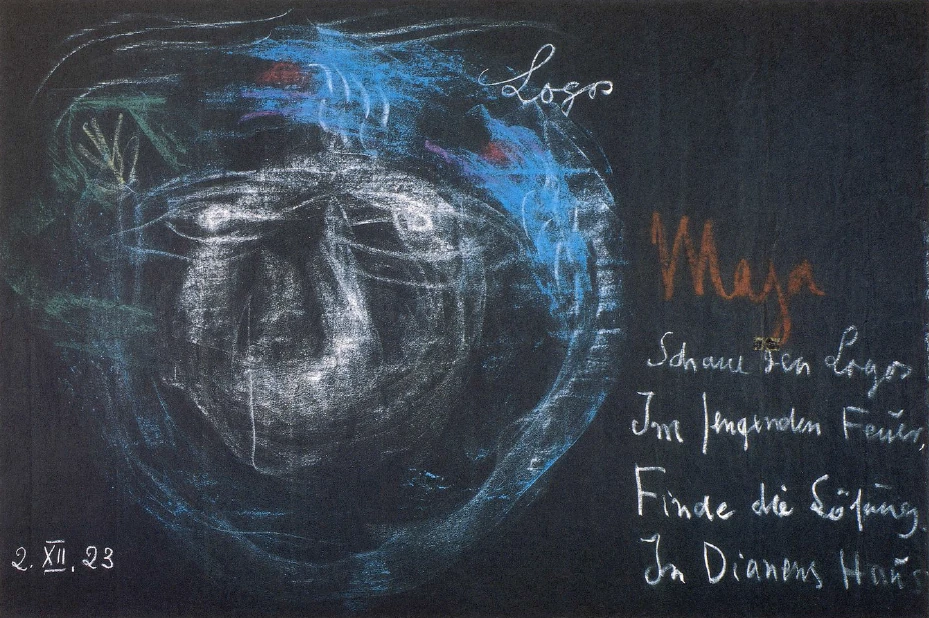
Behold the Logos
In the burning Fire;
Find the clue
In Diana’s House.
The Fire-Akasha of New Year’s Eve speaks these and many other words very clearly. And it demands of us that we understand the Micrologos in the Microcosmos, so that man may gain understanding for that from which his own being proceeds, for the Macrocosmos through the Macrologos.
-
For the German original see end of lecture. ↩
Blackboard drawings
2 drawings Steiner made on the board during this lecture, as the publisher's edition prints them.