Record: record unknown How this text was taken down is not on record here. That is not an assurance of a stenogram.
A Spiritual Scientific View of Nature and Man
GA 352 — 27 February 1924, Dornach
VIII. Einstein's Theory of Relativity — Thinking that is out of Touch with Reality
Good morning, gentlemen! Has anyone thought of anything for today?
Mr. Burle asks about the theory of relativity and how it is viewed today. He says that people used to read a lot about it, especially in the past. Now it may have been forgotten again; at least he doesn't hear as much about it as he used to.
Dr. Steiner: Well, you see, the matter of the theory of relativity is a difficult one, and today you will probably have to be very careful and in the end you will have to say that even if you are careful, you are not familiar with it. But that is the case with many people who talk about the theory of relativity today. They talk about it in such a way that they often praise it as the greatest achievement of our time, but do not understand it. I will try to explain it as popularly as possible. As I said, it will be difficult today, but next time we will come to more interesting things.
Einstein's theory is based on the motion of a body. You know that bodies move by changing their position in space. So if we want to record a motion, we say: a body is at a location A and moves to another location B. If you are standing somewhere outside and see a train passing by, you will have no doubt at all that the train is rushing past you, moving, and you are standing still. But you can easily come to doubt it, at least for the moment, of course, if you are not thinking deeply, if you are sitting somewhere in a railway compartment and are asleep at first, then wake up and look out the window: a train is passing by. You have the distinct feeling that a train is passing by. That does not necessarily mean that it is true, however. Before you fell asleep, your train was stationary, and while you were sleeping, your train itself began to move. While you were sleeping, you did not notice that your train was moving, and the other train appears to be passing by. If you look more closely, the train standing outside is completely still, while your train is moving. So while you are moving, you believe that you are at rest, and the other train, which is really at rest, is moving. You know, it can also happen that you look out the window and believe that you are sitting quietly in the train you are currently on, while the whole train is moving in the opposite direction. That's how it looks to the eye. You can see that what we humans say about movement is not always true. You wake up and form the judgment: the train that is outside is moving. Immediately afterwards, you have to correct yourself: that is not true at all, it is standing still; I am moving!
Such a correction of judgment occurred once in a major way, or even more than once, in world history. We need only go back six or seven centuries, when everyone was of the opinion that the earth was stationary in space and that the entire starry sky was moving past. This view was corrected, as you may have heard, in the 16th century. Copernicus came along and said: All that is wrong; the sun, the fixed stars are actually stationary, and we with our Earth fly at breakneck speed through space. We believe to be at rest on Earth - just as one previously believed to be at rest in the railroad car and the other train was driving and have now corrected that. Copernicus corrected the whole of astronomy, saying: It is not true that the stars move; they are stationary. But the Earth, with people on it, rushes through space at a tremendous speed.
You have given the possibility that it is not immediately possible to tell from observation what is actually correct with regard to motion: whether one is at rest oneself and a passing body is really in motion, or whether one is in motion oneself and a body that one believes is passing by is at rest.
Don't you think so? When you consider this, you will say to yourself: Yes, a correction may be necessary for everything we recognize as movement. Take, for example, how long it took for all of humanity to correct its judgment regarding the Earth. That took thousands of years. When you sit in a train, it may take only a few seconds for you to correct your judgment. So it varies how long it takes to correct such a judgment.
This has led people like Einstein to say: We cannot know whether what we see in motion is really in motion, or whether we, who are standing still, are not somehow mysteriously in motion and the other in rest. So we draw the final conclusion from this uncertainty.
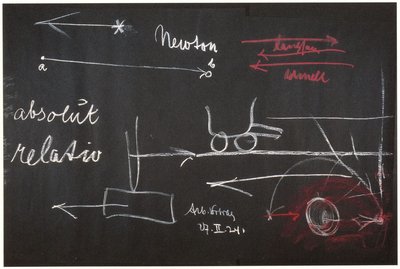
Well then, gentlemen, it could be like this: let us assume there is a car here (a picture is shown). In this car, one drives from Haus Hansi up to the Goetheanum. But who can say for sure that the car is really driving up? Who can say that with certainty? The car could be standing still, the wheels could be turning, and the whole Goetheanum that one is approaching could be moving in the opposite direction. We would only have to experience something like this for the Earth as Copernicus did for the Earth! (Laughter.)
Einstein took such things and said: We can never be certain whether one or the other body moves. We only know that they move in relation to each other, that they change their distances; that is the only thing we know. Of course, we know that when we travel to the Goetheanum, because we come closer to the Goetheanum; but whether we come to it or it comes to us, we cannot know. Now, you see, what we can say is that it is in real rest or real motion, that is absolute. So what is an absolute rest or an absolute motion? That would be a rest or motion of which one could say: In the universe, the body is at rest or the body is moving. But of course this is always a fatal thing, because at the time of Copernicus, it was still believed that the sun was stationary and the earth was moving around it. In relation to the earth it is correct, but in relation to the sun it is not correct, because the sun moves very fast, rushing at a tremendous speed through the starry universe, which is in the constellation of Hercules – and of course we are all with it. On the one hand we revolve around the sun, but with the rotation around the sun we rush with it through space. So we cannot say that the sun is at absolute rest in space either. And so Einstein and those who shared his view said: You cannot say at all whether something is at absolute rest or in motion, but you can only speak of things being in relative rest - relative, that is, with respect to each other - it appears to one to be at rest or in motion.
You see, gentlemen, during a course that was held in Stuttgart, someone once believed that we anthroposophists know nothing of note about the theory of relativity. And so, because he was or is a fanatical supporter of the theory of relativity, he wanted to make it clear to people in a very simple way how the theory of relativity, Einstein's theory of relativity, really applies. What did he do? He took a matchbox and said: “Here is a match. Now I hold the box very still and move the match towards it. It catches fire. But now I'm going to do a second experiment. Now I'm going to hold the match very still and move the box towards me. It catches fire again. The same thing happens. What has happened is that fire has been created, but the movement I have made is not absolute, it is quite relative. One time, when the box is there and the match is there, I move the match this way, the other time I move the box. For fire to occur, it does not matter whether the box or the match moves, but only whether they move relative to each other, in relation to each other.
But this can be applied to the whole world. You can say for the whole world: the thing is that you don't know whether one or the other moves, or whether one moves more strongly or weakly, or whether the other moves more strongly or weakly. You only ever know how they move in relation to each other, whether they come closer or further away from each other; you don't know more than that. And you don't know whether one body moves faster or slower than the other. Imagine you are traveling in an express train rushing by terribly fast, and a passenger train passes by outside, you look out the window. You can't judge what is actually going on, because at the moment when you are traveling in the express train and the passenger train is traveling in the opposite direction, you have the feeling that your express train is traveling much slower than it used to. Just try it. At that moment you have the feeling that now the train is moving slowly. In perception, so much of the speed is taken away from the fast as it approaches you. So you get a completely false judgment about the speed of the movement in your own train. If, on the other hand, someone is traveling more slowly next to you, you feel as if your train is traveling faster. So you never have a judgment when you see two movements and how they actually relate to each other, but you only ever get a judgment about how the two bodies relate to each other in terms of their distances.
Now you can stop at this point and say: Gosh, Einstein was a clever guy, he finally realized that in the universe we cannot talk about absolute motion at all, but only about relative motion. That is clever, and as you can see, it is also correct for many things. Because no one can say that when he sees a star at rest, it is a star at rest. If you move at a certain speed, the star appears to be moving in the opposite direction; but it could also be moving towards you. So you can't possibly conclude from looking at it that the star is at rest or in motion. It is necessary to know this, because the fact that we finally know this today means that we would have to change the entire terminology used in certain sciences. I will show you this with an example.
How do you get knowledge from the stars at all? You see, you can't get knowledge from the stars if you have the same view as the prince who went to the observatory. The astronomer naturally had to show him the observations he made of the stars because the prince was the ruler of the country. Well, he also let the prince look through the telescope, and they observed a star. When you point the telescope somewhere, you don't see anything at first. Then you wait a little; then the star comes into the telescope, as they say, and then it comes out on the other side. The prince watched this. Then he said: Yes, now I understand quite well that you know something about the stars, that you know where the stars are and how they move, I can see that quite well now. But how you, when you are so far away, come up with what the stars are called, I still can't understand. — With such views, of course, one cannot pursue astronomy. But how does it happen when you observe stars? There is the telescope; the astronomer sits there, and he looks in with his head from above, and there are crosshairs here; and when the star appears to move like this, you don't see anything yet, and when it is here, you see the star. If it is visible exactly where the threads cross, then you determine the location of the star.
Now, it was always thought that when observing, one could say: either the Earth moved, or the telescope was moved forward and the lens – that's what the glass that is far away is called; the glass that is close is called the eyepiece – was moved so far that the stationary star can now be seen inside. In the past, people believed that the star was moving. Today we have to say: We know nothing about the rest or motion of the star. We can only say: In the viewfinder, the crosshairs of my telescope coincide with the view of the star; the two overlap. We can say nothing more than what we have directly in front of us. We would be uncertain about the whole world as a result.
This has far-reaching consequences. It is important for our view of the motion not only of the heavenly bodies, but even of the bodies on our earth. And the conclusions that Einstein and those who think as he does drew from it are very far-reaching. They said, for example: Yes, if motion is only relative, if it is not absolute, then one cannot say anything real about anything at all, not even about simultaneity or different times. If, for example, I have a clock in Dornach and another in Zurich and the hands are in the same position, I am still not at all sure that, because they are far apart, in reality there is only one erroneous observation; perhaps there is no simultaneity at all!
So you see, the most far-reaching conclusions have been drawn from this. And the question arises: can we not get out of this at all? Can we not say anything at all today about the things themselves when they move? That is the important question. It is quite certain that nothing can be said from the observation of the movements. And in the broadest sense, it is also true that if I drive up to the Goetheanum in my car, it may just as well be that the Goetheanum comes towards me.
Yes, but there is one thing, gentlemen, that does happen. Even the example I gave you with the matchbox is not quite right. Because, you see, I would have liked to shout to the gentleman who made it so finely: “Why don't you nail the matchbox to the table and then try to move it back and forth!” You have to apply at least a great deal of force if you have to drive with the whole table back and forth. — So there must be a catch somewhere.
You can recognize this catch if you only approach the matter attentively. Suppose you drive from Dornach to Basel, and now you could say: It is not true that the car moves; rather, the car remains stationary, only turning the wheels, and Basel comes towards it. — Fair enough. But there is one thing that speaks against this: the car will be ruined after a few years. And the fact that the car is ruined can only be attributed to the fact that it is not the road that moves, but the car that moves and is ruined by what happens inside it. So if you don't just look at the movement, but look inside the body itself to see what the movement does, you will come to the conclusion that you cannot fully grasp Einstein's conclusion. So you can notice that the car is actually being ruined, not just the wheels, because they are turning. Now someone might say: Yes, they would of course also turn if a mountain were to come towards you or Basel were to come towards you, or otherwise the thing would wear out. But you can still say: maybe that's the way it is. With inanimate bodies, the matter cannot be decided at all, and for inanimate bodies one can only say that it is uncertain which way the one or the other moves. But the living organism! Imagine you are walking to Basel and someone else remains standing here in Dornach, remains standing for the whole two hours while you walk to Basel. Now, if it were not you who had moved but Basel who had come to meet you, you would have done almost no differently than the person who remained standing. But you became tired; a change took place in you. From this change that takes place within yourself, you can see that you have moved. And in the case of living bodies, it is possible to determine from the changes that take place within them whether they are really in motion or only in apparent motion, at rest.
But this is also what must lead us to recognize that we cannot form a theory from the external observation of the world, not even from something as clear as movement. Instead, we must form our theory from the internal changes. Well, there you have it again: with the theory of relativity, too, one must say that he who looks only at the outward side of things comes to nothing at all. One must look at the inner side. It is precisely this theory of relativity that leads one to at least begin with spiritual science, with anthroposophy, because anthroposophy points out everywhere that one must look at the inner side.
Einstein's theory has led to some extraordinarily strange consequences. The matter becomes particularly interesting, for example, when Einstein gives his examples. He gives an example in which he wants to prove that the change of location has no significance at all. Because it cannot be determined from the point of view whether a body changes its location or not, the change of location cannot have any significance. That is why Einstein says: If I hurl a clock that has a certain hand position out into space, so that it flies out at the speed of light and then turns around and comes back, this movement has had no significance for the inside of the clock. The clock comes back unchanged. That is how Einstein makes his examples: whether a body moves or not, we cannot decide. The clock is the same whether it is at rest or moving, it is the same for it. - Yes, but, gentlemen, you should just be invited to look at a clock that flies out into space at the speed of light and comes back again! The clock, yes, you won't see it at all anymore. It will be so pulverized that you won't see it.
But what does that mean? It means that you cannot think that way at all. You come to thoughts that are thoughtless. And so you find on the one hand that Einstein is a terribly clever person and that he draws conclusions and makes judgments that are terribly captivating to people. Not true, the ordinary people who are not very good mathematicians, they don't understand much of Einstein's theory; and then they start reading about Einstein's theory in some popular book, read the first page, then yawn; read half of the second page, then stop. And then they say: It must be something terribly clever. Because if it wasn't something terribly clever, then I would have to understand it. Besides, a lot of people say that it's something terribly clever. –That's where the judgment about the theory of relativity comes from. But there are also people who understand it. And it is among such people that Einstein finds his following, and that following grows larger every day. It is not, as Mr. Burle says, forgotten. A few years ago, when you spoke with university professors, they did not want to know anything about Einstein's theory. Today, everything is full of the erudition of Einstein's theory of relativity.
But people also come up with some very strange ideas in the process. For example, I once had a debate with university professors about Einstein's theory. Yes, you see, as long as you stay in the area that I have also discussed with you, Einstein's theory of relativity is correct; there is nothing you can do about it: it is like that with the train, with the solar system, with the movements of the whole world. So far it is quite correct. But now the gentlemen extend it to everything and say, for example: Relative is also the size of a human being; he has no absolute size, but only relative. That seems to me only that he is so high. He is so high in relation to — well, if we are here —, in relation to the chairs or in relation to the trees, but one cannot speak of an absolute size. You see, that applies as long as you remain a mathematician, as long as you are only concerned with geometry. The moment you stop being concerned with geometry, when you enter life, that's when the pleasure stops, that's when it's different! You see, if someone has no feeling, then he can carve a head out of wood that is a hundred times as big as your head. Then he has it. Yes, the one who has a feeling for it will never do that because he knows that the size of a human head is not relative, but is conditioned in the whole of space. It can be a little larger or a little smaller, but if someone is a dwarf, it is an illness; if someone becomes a giant, it is also an illness. It is not just relative, but the absolute is already visible. Within certain limits, of course, human height fluctuates. But in the universe, a person is definitely intended for a certain height. So again, one cannot speak of relativity. One can only say that man gives himself his own size through his relationship to the universe. There was only one of the college of professors with whom I had the debate who admitted that. The others were so twisted in their heads by the relativity theory that they said that human size is also only relative because we look at it that way.
You know, if you have a picture, it can be large; if you go further, it gets smaller and smaller according to the perspective. The size of this picture that you see is relative. The relativists believe that human size is only as it is because it is always seen against a background. But that is nonsense. Human size has something absolute about it, and a person cannot be much taller or much shorter than he is predetermined to be.
Now, people think all this up because they generally do not form any opinion about what is involved in a process or in a thing that happens on earth in our environment. From what I have already told you, you will be able to deduce the following: there is the earth; on the earth is some human being. Now you know, however, that the human being is not only dependent on the forces of the earth, but he is dependent on the forces that come from the universe. Our head, for example, reflects the whole universe. We have discussed this. If it did not matter how tall a person is, what would have to be there? Suppose Mr. Burles' head, Mr. Erbsmehl's head, Mr. Müller's head is formed from the universe. Yes, gentlemen, if the heads are three or four times different from each other, there should be an extra universe for each one. But since there is only one universe, which does not grow or shrink because of the individual human being, but is always there, remaining the same, the heads of people can only be approximately the same. It is only because people do not know that we live in a common world that also has a spiritual effect that people can believe that it is irrelevant how big a person's head is, that it is merely relative. It is not relative, but it is dependent on the absolute size of the universe.
So we come back to having to remind ourselves: it is precisely when you think correctly in relation to the theory of relativity that you enter into spiritual science, not into materialistic science.
And if you then look more closely at people, you see that people who think like Einstein run out of ideas when they come to life or to the spiritual. You see, when I was a boy, I was able to take part in the lively debates that took place about gravity. Gravity - when a body falls to the earth, it is said to be heavy. It falls down because it has weight, because it is heavy. But this force of gravity is everywhere in the universe. The bodies attract each other. If there is the earth and there is the moon (see drawing), then the earth attracts the moon, and the moon does not fly away, but moves in a circle around the earth, because the earth, when it wants to fly away, always pulls it back towards itself. Now, in the past, when I was a boy, there was a lot of debate about what this force of gravity is actually based on.
The English physicist Newton, whom I have told you about before, simply said: bodies attract each other, one body the other. That is not a very materialistic view, because if you imagine that a person should just touch something and draw it towards them, all sorts of things besides matter are needed to do so. If now the Earth is to attract the Moon, then this cannot be reconciled with a materialistic view. But materialism flourished precisely in my youth. One could also say that it dried up people, it withered, but one could also say that it flourished. So people said: That's not true, the Earth cannot attract the Moon, because it has no hands to attract it. That's not possible. So they said: the world ether is everywhere (see drawing). So what I am drawing in red here is the world ether; it also consists of nothing but tiny little grains. And these tiny little grains, they bump into each other here, bump into each other there, but bump more strongly there than they do in the middle. Now, when there are two bodies, the Earth and the Moon, and the impact from the outside is stronger than from the inside, it is as if they were attracted to each other. So the force of attraction, the force of gravity, was explained by the impact from the outside.
I cannot begin to tell you how much cognitive pain this caused me at the time. From the age of twelve to eighteen, I really agonized over whether the Earth attracts the Moon or the Moon is pushed to the Earth. Because, you see, the reasons given are usually not exactly stupid, but clever. But there is already a certain relativity theory in that. One wonders: is there anything absolute in it, or is everything relative? Is it perhaps really immaterial whether one says that the Earth attracts the Moon or that the Moon is pushed towards the Earth? Perhaps one cannot decide anything at all. Well, you see, people have thought about this a lot. And what I actually want to say is: At least they came up with the idea that there is an ether in addition to the visible substance. They needed the ether, because what is supposed to push if not the grains of ether! When Einstein first established his theory of relativity, everyone still believed that the ether had to exist. And Einstein then thought of everything he had described as relative motion as taking place in space, which is filled by the ether. But then he realized: Gosh! If motion is only relative, it is not at all necessary for the ether to be there. Nothing needs to push, nothing to pull. We cannot decide anything about this. So space can also be empty.
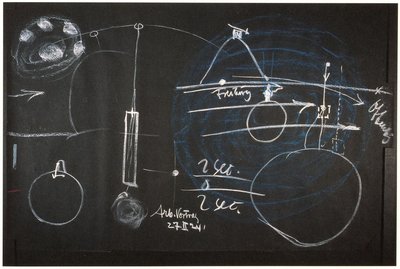
And so, over time, there are actually two Einstein theories. Of course, they are united in one person. The earlier Einstein described everything in his books as if the whole space of the world were filled with ether. Then his theory of relativity led him to say: space is empty. Only, the theory of relativity is not about saying anything about ether, because we don't even know if it is so. The examples he gives sometimes become quite grotesque. For example, Einstein says: If there is the earth, and there is some tree, I climb up; here I slip, fall down – this is an occurrence that you have probably also experienced; at least as a boy I very often experienced it when I climbed up a tree, that I slipped and fell down – then you say: Well, the earth is pulling me. I have a weight. This comes from gravity, otherwise I would have remained in the air, otherwise I would be wriggling if the earth were not pulling me. — But Einstein says you can't say any of that, because think of the following: There is the earth again, and now I am up there on a tower, standing; but I am not standing in a vacuum, surrounded by free space. Rather, I am standing in a box that is suspended at the top. If I were to fall out of the box from the tower, my relationship to the walls would always remain the same. I don't notice any movement, the walls go with me. Yes, by golly, now I can't tell whether the rope from up there, on which my box is hanging, will be lowered and I will arrive at the bottom of the box because someone is lowering me from above, or whether I can arrive, whether the box will slip because the earth is attracting me. I can't decide that. I don't know whether I'm being lowered or whether the earth is drawing me towards it.
But with this example, which Einstein chooses, it is just the same as with the other comparison that is always used in schools. There the children are already told how a planetary system is formed, that there is a nebula at first, out of this nebula the planets separate. In the middle, the sun remains. They say: That can easily be proven. You take a small oil droplet that floats on water, in the middle a sheet of card through which a pin is stuck, you put that in the water, start to turn it. Then small droplets split off from the large one, and a tiny planetary system is there. That's how it must be out there. Once there was a nebula; the planets split off, the sun remained in the middle. Who could possibly disagree with this, if you still see it in the fat droplet today! Yes, but one little thing has been forgotten, gentlemen: that I have to stand there and turn when I am the teacher in front of the children and show that! If I don't turn: nothing forms from a small fat planet system! So — the teacher would have to tell the children — there must be a great teacher, a giant teacher out there who once turned the whole story. Then the example is complete. And so Einstein, if he were to think in complete accordance with reality – if he even gets around to formulating such a thought – would have to assume that someone is directing the rope up there. That is necessary right away. Otherwise you cannot say: It makes no difference to me how I come down, whether someone lets me down or whether I tumble; there must be someone up there. So if Einstein were to elaborate on this example, he would immediately have to consider: who is there to hold the rope? He does not do this because contemporary materialism forbids it. Therefore, he devises examples that have no reality, that cannot be imagined, that are impossible to think.
And there is something else connected with this. Imagine, gentlemen, there is a mountain. There is Freiburg im Breisgau. On the mountain I set up a cannon so that you can still hear the shot in Offenburg on my account. But you hear the shot later. If someone notes on a clock when they heard the shot in Freiburg and when someone heard it in Offenburg, they will see that the times on the two clocks differ. The sound took some time to travel from Freiburg to Offenburg.
Now, you see, this story has also been used for the so-called theory of relativity. Because it is said: Let us now assume that I am not standing in Offenburg listening to when the sound arrives, but that I am initially standing in Freiburg. There I hear the sound simultaneously as it arises. Now I am traveling by train in the direction from Freiburg to Offenburg. Because I am traveling ahead, a little way from Freiburg, I hear the sound a little later than it occurs. Even further towards Offenburg, a little later again; even further towards Offenburg, a little later again.
But this only lasts as long as you drive slower than the speed of sound. If you drive just as fast as the speed of sound from Freiburg to Offenburg, what happens then? If you drive just as fast, at the same speed as the speed of sound: you arrive in Offenburg, and there it runs away from you, you still don't hear it. If you travel at the same speed, you will never hear it, because by the time you are supposed to hear it, it will have gone. You are supposed to hear it, but by then it is no longer there. Now people say: Gosh, that's right, you can't hear sound if you're moving as fast as sound itself! And if you move even faster than sound, what happens then? If you go slower, you hear it later; if you go just as fast, you don't hear it at all. If you move faster, you hear it earlier than it sounds! People say that this is quite natural, that this is quite correct. So if you hear the sound in Offenburg two seconds later when you move slower than the sound, you don't hear the sound at all when you move at the same speed as the sound. But if you move faster than the speed of sound, then you will hear it two seconds earlier than when it is released in Freiburg! I would just like to invite you to listen, really listen to the sound before it is released in Freiburg! You can see for yourself whether you hear it earlier, no matter how fast you are moving.
The other objection is that I would then like to ask you what you look like when you move so fast or even faster than sound.
What follows from this? It follows that you can think anything if you don't stick to reality. With this theory of relativity, you end up with the idea that you hear the sound earlier than the shot is released! (Laughter.) You can think of it quite well, but it can't happen. And that, you see, is the difference! People who do science today mainly want to think logically; and Einstein thinks wonderfully logically. But the logical is not yet real. You have to have two qualities in your thinking: first, the things have to be logical, but second, they have to be real. You have to be able to live in reality. Then you don't think up this box that is pulled up and down on a rope. Then you don't think of the clock that flies out into space at the speed of light and back again. Then you don't think of the guy there who moves faster than the sound and therefore hears the sound earlier than the shot takes place. Much of what you read in books today, gentlemen, as such considerations, is very nicely thought out, but none of it is in reality.
And so we can say: Einstein's theory of relativity is clever and it also applies to a certain part of the world, but you can't do anything with it when you look at reality. For from the theory of relativity one never comes to understand why a person tires so terribly when he goes to Basel, since he cannot say whether he is going into Basel or whether Basel is coming to meet him. The fatigue could not be explained if Basel were to come to him, and why I fiddle with my feet when I walk; I could stand still, wait for Basel to come to me! You see, all these things show nothing other than that it is not enough to think correctly and intelligently, but that something else is needed: one must be immersed in life and must judge things according to life.
That is what I can tell you about the theory of relativity. It has caused a great stir, but, as I said, people understand it only a little, otherwise they would already be thinking about these things.
So, see you next Saturday.
Blackboard drawings
2 drawings Steiner made on the board during this lecture, as the publisher's edition prints them.