Record: listeners' notes Written from listeners' notes, summaries or memory; the wording is the note-taker's as much as Steiner's. Evidence: «Lory Maier-Smits, Aufzeichnungen 1965»
The Origin and Development of Eurythmy 1912–1918
GA 277a — Munich
Notes on the Development of Eurythmy (Munich, summer 1913)
Lory Maier-Smits, Notes from 1965
Until about mid-June, this work continued in our small, closed circle in the manner described, and soon after that I traveled to Munich for the second time to attend rehearsals for the Mystery Plays. There, Erna Wolfram and I met again, unfortunately without Annemarie Donath.
The rehearsals were again in the familiar gymnasium. — Dr. Steiner explained right at the beginning that in the second scene of the new play, The Awakening of Souls, two groups of elemental spirits would appear, which would have to be represented by the new art of movement, eurythmy. For about a year, a small circle had been working quietly on the beginnings of this new art form according to his instructions, and now this eurythmy was to be used for the first time in the representation of the gnomes and sylphs choirs.
He also immediately determined the personalities who were to participate in the two groups; there were also a few gentlemen among the gnomes, and then he said to me: “Well, Miss Smits, you know the laws and can therefore design the forms for these groups. During the lunch break, work first with the ladies I have chosen for the sylph choir, then I can do something this afternoon.”
So we, the “sylphs” chosen by Dr. Steiner and I, met again in the gym shortly after lunch. After I had first shown how the various vowels and diphthongs, for that was all we were concerned with, were made, we went straight to practicing line by line without any theoretical explanations. I stood in front of the group, slowly pronouncing the vowels, emphasizing the stressed ones in particular, and forming all the movements just as slowly and emphatically. It went amazingly well right away; it was certainly no coincidence that Dr. Steiner had chosen these particular personalities for the Sylph choir. In the stage directions, these beings are described as follows: “From the right come sylph-like, slender, almost headless figures, their feet and hands are a cross between fins and wings; some of them are blue-green, others yellow-reddish. The yellow-reddish ones have sharper contours; the blue-green ones are more indistinct.”
And so a row of beautiful, slender figures stood before me, for whom it was not difficult to make large, airy, floating movements, which would probably also glide, as if swimming in space. But we were not that far along on this first afternoon, instead focusing exclusively on arm movements; except for Erna Wolfram, it was completely new territory for everyone involved, and they had to find their way into it, but they did so with ever warmer enthusiasm, ever more naturally and joyfully. You will believe me when I say that this enthusiasm for eurythmy was carried through an entire lifetime when I mention names such as: Tatiana Kisseleff, Alice Fels, but also Margarita Woloschin and Miss Maryon, who later created the first eurythmy figures, and last but not least Erna Wolfram-van Deventer, who had already been devoting herself to this new art for several months. In addition, there was a Polish woman and a Russian woman, both of whom were also very tall and slender figures.
I myself was to participate in the gnome choir. Rudolf Steiner himself demonstrated to us, the astonished and admiring audience, the way the gnomes were to move, which was very different from everything we had learned and practiced so far. The stage directions for these gnome spirits state: "They have steel-gray figures that are small compared to humans; they are almost entirely head; but this is bent forward. They have long, flexible limbs that are suitable for gestures but clumsy for walking.“ Rudolf Steiner now took a parasol in each hand and, with these ”extended" arms, made quite harsh, very characteristic movements that were very striking due to his protruding head (all vowels). In addition, he moved with his knees bent from the outset in small triangular shapes, emphasizing the corners very sharply with jerky stops, as if he were stumbling in each new direction, surprising and even frightening the audience.
We had often marvelled at his unsurpassable versatility, for example when he demonstrated Lucifer or Ahriman in rehearsals to the respective actor standing next to him, but this was something else entirely! A grotesque being, completely alien to our way of life, moved before us with frightening intensity, confidently mocking our human wisdom as stupidity.
The painter Imme von Eckardtstein, who was to play the role of “Lucifer” for the first time this year, eagerly sketched Dr. Steiner's facial expressions. In addition to her major role, she was still the artistic director for the production of all the costumes, and since this work was also carried out according to Dr. Steiner's intentions, she already knew how we would be transformed into beings who were “almost entirely head.” And so she used these sketches when she later painted the faces herself on the oval, wide stoles that we wore as heads over our shoulders, which were shaped like shaggy eyebrows, while our own heads were covered by a kind of gauze fan or comb.
I have already mentioned that Dr. Steiner had also determined the personalities for this choir. But I must now tell you that after the dress rehearsal, Dr. Steiner expressed his satisfaction with this group in a truly beaming manner: “You have really found all the characteristic movements of these gnome spirits, except for one that these beings do very often, but that would have been too cheeky!” As he said this, he made a “long nose” at me with a laugh! But I told him honestly that this praise was not due to me, but largely to the Danish Baroness Walleen, because without her original and imaginative collaboration, everything would certainly have been much duller and more boring. Even the character of a “long nose” was actually inspired by her suggestion to make the ‘i’ vibrate a little at the point where we “giggle.” She was a wonderful help, and I will always remember our joint “discovery work” in the realm of these elemental spirits with gratitude and joy.
In this last Munich festival year, all four mystery plays were performed within a week, with a day off in between for the audience, but for Dr. Steiner and the performers, this day was filled with dress rehearsals in the morning and afternoon. Dr. Steiner was often at the theater as early as 7 a.m. to hold rehearsals with the stagehands! And when he didn't show up one day, the stagehands became very anxious: “The dear old gentleman isn't sick, is he?” Incidentally, Dr. Steiner gave each of these people a copy of the book that had been published at the beginning of the plays.
About fourteen days before our last performance, Rudolf Steiner called me to him and said that he still needed an “Egyptian dance” for the eighth scene – the Egyptian temple scene! He had decided to place the four priests, who according to the director's instructions were to stand at the front, slightly elevated, at the very back against the backdrop. They would have to stand there completely motionless throughout the entire scene, and only when the neophyte, to the surprise of all those gathered in the temple, uttered not the expected “words of the world” predetermined by ancient rules, but his own experiences and feelings, would they have to express and accompany these words of the neophyte eurythmically, as if seized and compelled by them. Dr. Steiner also designated the personalities for this, namely, in addition to myself, Mrs. Woloschin, Baroness Dungern, and a French painter, Madame Péralté, who was participating for the second time as one of the Ahrimanic beings and this time also as one of the gnomes. She was an almost 60-year-old woman with an incredible temperament, full of concentrated energy, and her appearance, reminiscent of the desert and solitude, made her seem predestined for such a task.
Unfortunately, this energy was soon directed against me and my attempt to give this “dance” an “Egyptian character” by having us move only sideways, in the style of Egyptian reliefs. After Dr. Steiner had set this new task, I had excitedly rushed to various museums, and these sideways movements had really seemed like a saving grace, but unfortunately also the only idea I had. But Madame Péralté went on strike and refused to participate in such an “Egyptian fantasy.” She brought not only thick books but also an Egyptologist to the rehearsal, and finally Dr. Steiner said to me, the “accused”: “Then just leave out these sideways movements!” — When I left the hall after the rehearsal, feeling very depressed and helpless, and crept down the stairs, a hand suddenly rested on my shoulder. It was Dr. Steiner, who looked at me comfortingly, kindly, but also almost a little slyly, and explained: "You know, I didn't mean to be pedantic when I said you should leave out those sideways movements, only the conclusion, you must do that completely frontally, the line: I felt your stern wake-up call! You see, this whole scene is a very specific, very real image that is inscribed in the Akashic Records. It is the moment when the first signs of the approaching Greek civilization light up for the first time, and that is why the conclusion really has to be done frontally, like a wake-up call!" I was able to pass on this delightful hint to the others, and it was not only sufficient, but also fueled our further work immensely, which is said to have been very impressive and convincing precisely because of the contrast between the “Egyptian relief-like” movements and this luminous-sounding conclusion.
After that, the four of us priests stood there again, as before, completely motionless. Only when the sacrificial priest uttered the words “Truth has triumphed!” in his last sentence did we have to make a single movement, which Dr. Steiner called a “sealing movement.” An unclosed o-movement upwards, which transitioned into a small s-movement, shining like a light. The “sacrificial priest” is, of course, the Egyptian incarnation of the historian Capesius, and in a rehearsal for this picture, Dr. Steiner once said as he walked through the hall: “Incidentally, for every serious historian, one can find an incarnation that took place in an Egyptian temple.”
Notes on “Truth has triumphed”
He drew the movement “Truth has triumphed” in my notebook.
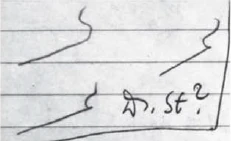
In Munich, Dr. Steiner did not give a drawing, and we did it a little differently, as I have sketched it, but with both arms, mirror-inverted. He guided my arms like an unfinished o or s and then “very quickly something like a 5 (five) on top of it.”
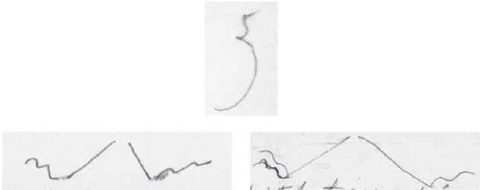
Marie Steiner, from: Notebook 144
Egyptian eurythmy – very symmetrical, geometric movements
may only be in 2 dimensions (expressing only the inner self).
Egyptian painting valuable for movement and expression of the inner self. Sculpture valuable for headdresses, drapery, and more external aspects.
Alice Fels, from: “On the Development of Eurythmy”
How vividly and animatedly he [Rudolf Steiner] then characterized the sylphs! Once he came to a special sylph rehearsal in the afternoon in the inn hall in Schwabing, where the rehearsals took place and where this time he had only one actress come to recite and the sylphs. [...] Then he practiced the two scenes (second and sixth pictures) with us tirelessly for hours. [...] He had us repeat the word “fantasy,” for example, over and over again with all the sounds, encouraging us from time to time with exclamations of “very nice! very nice!” Nevertheless, most of the sylphs gradually left, so that in the end only Rudolf Steiner and two “steadfast ones” remained.
Max Gümbel-Seiling, from: “With Rudolf Steiner in Munich”
Eurythmy made even the simplest theatrical gesture meaningful and illuminating, as Dr. Steiner showed us, for example, with the word “unfold,” by crossing his arms on the first syllable and unfolding them on the second. The actor playing Dr. Strader [...] asked whether he could use eurythmy to express the words during his spiritual vision in Tatensturm. “That will be very beautiful,” replied Dr. Steiner. “You will experience what eurythmy means for the future development of the art of acting.”
The eurythmists, as sylphs in the midnight of the world, accompanied Theodora's words with hand gestures, especially with the spread finger posture of the a. After receiving thick veils at the costume rehearsal, they asked whether they should still do the a. “Why not?” asked Dr. Steiner. “Because you can't see it anymore.” “But it is there when it is done, even if you can't see it.”
Elisabeth Baumann-Dolifus, from: “Memories”
I also remember the great Egyptian initiation scene in the fourth mystery drama, where four priests stood in the background as silent participants, accompanying everything that was said with eurythmic gestures. The performers were Lory Smits and Erna Wolfram-van Deventer [...] and two other people for whom eurythmy was a completely new field. With an empathy astonishing for beginners, they allowed the words spoken by the actors to be revealed in their gestures, whereby every vowel (only the vowels were represented here), even the most insignificant, was expressed, and yet the solemn tranquility of this scene was completely preserved. Certainly, Rudolf Steiner's sustaining, invigorating presence worked through everyone and enabled people to achieve things that went far beyond the everyday.
Erna van Deventer, Notes on the “Personal Ego”
During the rehearsals for the Mystery Plays in Munich in 1913, we performers often had the opportunity to ask Dr. Steiner questions that arose from our work. For example, when asked about the impersonal pronoun “it” in the “Test of the Soul” in the fairy tale “Once upon a time there was a boy” (in “The Fairy Tale of the Spring Miracle”), he replied: "e above the head, and so for all fairy tales that begin with ‘Once upon a time’. The fairy tale was not performed eurythmically until later. But since I have always been interested in grammatical issues, I asked about the third person singular. R. Steiner answered and drew in my notebook: “Make a circle like a / with your hands, so that each hand describes its own circle, and then push through. But you can also do it with one hand, that is Es.”
“[...] Dr. Steiner [said] to me at the beginning of my time in Munich in response to my questions about what ‘Es’ means [...] (3rd person neuter, singular). He indicated and drew: ”Make a circle like an l, and then push through."
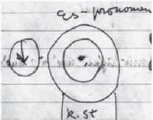
Dr. Steiner's answer was: “Make a circle with one or both hands at the same time like an /, and then push through.” // “Push forward.”
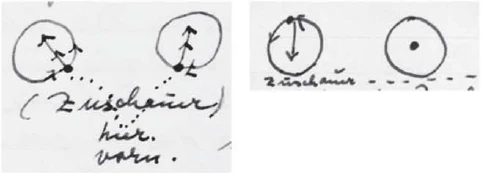
Audience here in front.